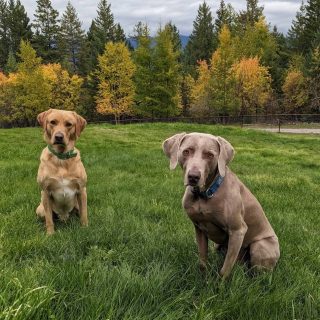
Lately I’ve been trying not to depend on training collars while walking my mutt Ace. I walked him on a flat collar all week, focusing on my energy, my voice and treats to get him to do what I want. And even though we’ve walked every day for the past year and a half, I noticed a difference in the last five days (must be the treats!).
I’ve picked up some ideas from dog trainer Paul Owens, who calls himself the original dog whisperer. In his book, “The Dog Whisperer: A Compassionate, Nonviolent Approach to Dog Training, 2nd Edition” (co-authored by Norma Eckroate), he says positive reinforcement training allows a partnership based on kindness, respect and compassion. Owens uses nothing but nonviolent, positive reinforcement training methods.
Basically, the key is proper communication.
Owens says nonviolence means no jerking, shocking, pulling or pinning (wait, what about when my mutt pulls me?). He instead uses treats, vocal praise, petting, clickers and life rewards such as playing, food or a walk to motivate the dog. He says substituting an unwanted behavior with a good behavior and using repetitions will condition a dog to do what you want him to do.
“The bottom line is that it is not necessary to use any jerking at all to get your dog to do what you want,” Owens said in his book.
He has a point.
I know I’ve pulled my dog’s leash too hard – training collar or not- out of frustration or impatience. That’s a terrible way to teach a dog anything. And honestly, Ace has learned to ignore my tugs and “leash corrections” anyway, so it’s time to try something new.
Owens answered the following question for my blog:
What is the most common misunderstanding when it comes to dog training?
Many people think dogs are in competition with them and that as the dog’s “master,” they have “to win” and force their dogs to “submit.”
There is no competition. We own everything our dogs want so it’s simply a matter of teaching them that they get whatever they want if they do something for us first. After a while, habits are formed and the behaviors become automatic. Until that happens, it’s our responsibility to keep our dogs, ourselves and the environment safe.
Many people also have a misunderstanding that they have to use physical punishment with their dogs in order to get off-lead, reliable behavior. Shaping reliable behavior is easy when you follow the rules.
When I began training 35 years ago, I never used treats although I did use generous praise and petting as well as life rewards such as freedom to jump in the pool, chase a ball, go for a walk, get on the bed, etc. Enforcement of “commands” (I no longer use that word) was primarily leash corrections, poking with my fingers and pinning a dog to the ground. I became very skilled in getting dogs to do what I wanted using these methods.
When I switched to positive training in 1988, I learned the difference between getting dogs to cooperate rather than forcing them to submit, how the scientific protocols of weaning a dog off of treats was essentially the same as weaning a dog off of aversives, and most importantly, how the methods used for training were as important as the results.
Regarding this last point, over time I learned of the link between how humans treat animals and how we treat each other, so I chose to stop using physical punishment or the threat of physical punishment.
Recent Search Terms:
- the original dog whisperer paul owens+recommended food
- "training collar""paul owens""dog whisperer"
- paul owens dog training
- blackcarin terrier mix puppies
- positive reinforcement training leash
- positive paul pet training
- Paul Owens train dog on leash

I have that book and LOVE it… It was one of the first “dog books” I read that really clicked the lightbulb on. He has alot of great techniques. Good reading!
I am a firm believer in positive reinforcement. No matter how aloof or stubborn my guy gets, I do everything in my power to remain patient and he is coming around nicely.
Positive reinforcement is the best. We use the clicker and Biggie is so responsive to it. And, I think you get much more reliable long term behavior from positive reinforcement.
Ok, I admit I do use leash jerks occasionally, but they are more to get his attention than anything else.
Terrific post, as usual.
Good interview. I interviewed a police K9 trainer for a magazine story I wrote and he had been in a comparison study of dogs trained with positive reinforcement and those trained with harsher methods. All who took part had graphic proof that positive methods work better and faster.
Enlightning interview, Lindsay!
Mayra Calvanis last blog post..Check out the trailer for CRASH!
I disagree with the ‘so-called’ positive only method for a lot of reasons:
1- There is no such thing as ‘only positive’. Even if all you do is withhold a treat there still MUST be a negative in order to reinforce good behavior.
2- The words he uses ‘violence’, ‘force’, etc. conjure images of abuse. Using corrections properly is so far from abuse. A tug on the leash or the proper use of an e-collar isn’t violent. It also isn’t force. If you speed and get a ticket does that mean you are being ‘forced’ to drive slower? No! You still have the freedom to choose. Balanced dog training does the same, it outlines a structure with discipline but I teach clients to NEVER force a dog, alpha rolls etc. are useless. I want dogs to make decisions and learn problem solving.
3- It isn’t natural. What species communicates by simply rewarding, rewarding, rewarding? Dogs don’t do it amongst themselves. Of course the justice system in our country could use some help but imagine if humans lived like this? Imagine if there were no tickets, fines, jail time, etc. Imagine if humans didn’t use corrections.
4- There is no way in the world that treat and praise only based training will EVER earn the respect of your dog. How could it? If a dog is faced with two choices and they are ‘get a treat by doing x’ or ‘don’t get a treat by doing x’ how on earth will that ever teach a respect for leadership? Teaching respect doesn’t require harshness but it only makes sense to use corrections.
5- High levels of obedience are incredibly difficult and time consuming with ‘purely positive’ methods. I know that they are out there but I have never met a dog that was trained with ‘positive only’ method that was halfway impressive. To be effective with this style of training is far too difficult for the average dog owner. Those that do have success usually require months and years to achieve something that could have been achieved in minutes or weeks by communicating in a more natural way.
6- Limitations. I have made a name for myself in my local market because I can fix aggression issues very well. Many dog owners go to ‘positive only’ trainers only to be told that their dog should be put down. These trainers just don’t have the tools to work with challenging cases. To me, that is far more inhumane than using more traditional and effective methods involving training collars.
As always, good post. It is nice to see various perspectives.
I think it depends on what works best for the dog and the owner. In most cases, it is going to be a combination of many methods.
I don’t like to depend on treats, but in many situations it keeps my mutt’s attention. I like to use training collars until the dog reaches a certain point in the training where he doesn’t need the training collar any more. And my dog is trained to stay in a big yard with the help of an e-collar. None of these collars have ever hurt him.
Still, Paul Owens says he does a lot of work with aggressive dogs and he says he is successful using only positive reinforcement methods.
I say, use whatever works.