There is no dog training collar that is right for every dog.
I have recommend every type of dog training collar to someone at some point. Every dog is different, and every owner is different. What works for my dog is not necessarily going to work for your dog. I don’t admire dog trainers who try to push a single tool on everyone.
All dogs are going to respond well to a strong, fun leader who uses positive reinforcement along with corrections. A responsible mother rewards her kids, but she’s not afraid to tell them no.
Shock collars, choke collars, pinch collars, buckle collars, Gentle Leaders, Haltis, anti-pull harnesses and martingale collars all work well for certain dogs.
The two collars I want to focus on for this post are the Gentle Leader and the pinch (prong) collar, mostly because they are on the opposite ends of the “spectrum.”
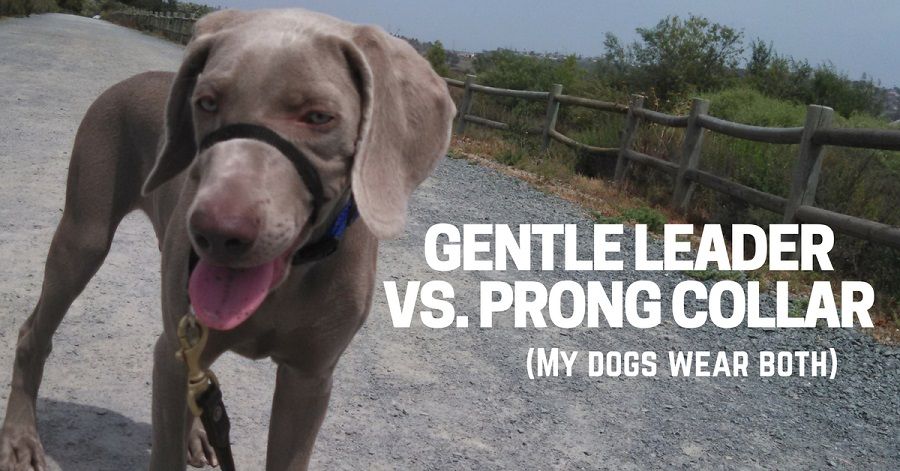
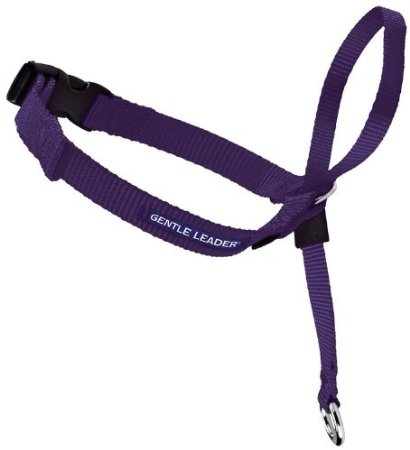
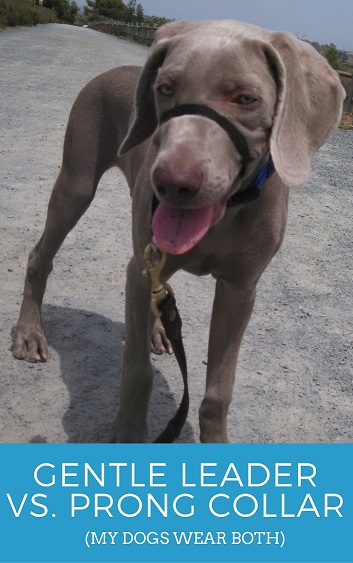
The Gentle Leader is marketed as a gentle option to be worn over a dog’s muzzle, similar to a horse halter. The Gentle Leader is designed to prevent pulling because if the dog handler controls the dog’s head, he controls the dog. Most dogs are also quite a bit calmer while wearing a Gentle Leader.
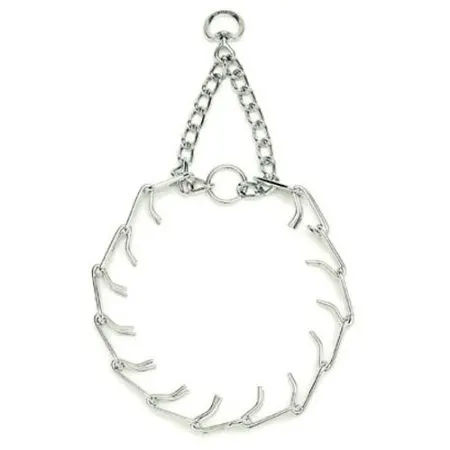
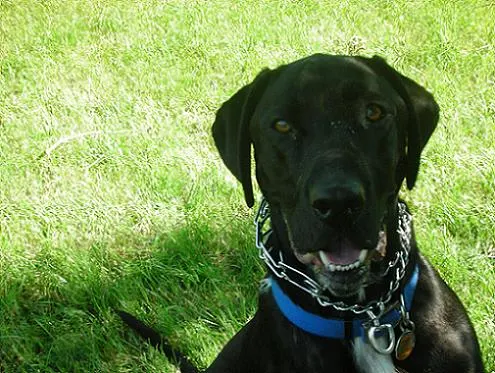
A pinch (prong) collar is usually made out of metal and has prongs distributed evenly around the collar. It should be worn high on the dog’s neck, right under his chin and behind his ears. When the dog pulls, the owner gives a slight “correction” by pulling up or to the side. This correction is not designed to cause pain. It is intended to re-direct a dog’s attention.
Let me explain what I like and don’t like about each of these collars. I hope to disprove some of the assumptions about each.
Gentle Leader for dog training
When I was teaching my mutt Ace to walk nicely on a leash, I used the Gentle Leader in some situations and a pinch collar in others. Now that I have another maniac on a leash (A.K.A. Cosmo), I am once again using both tools – separately, of course.
What I like about the Gentle Leader
The Gentle Leader helps a dog remain calm
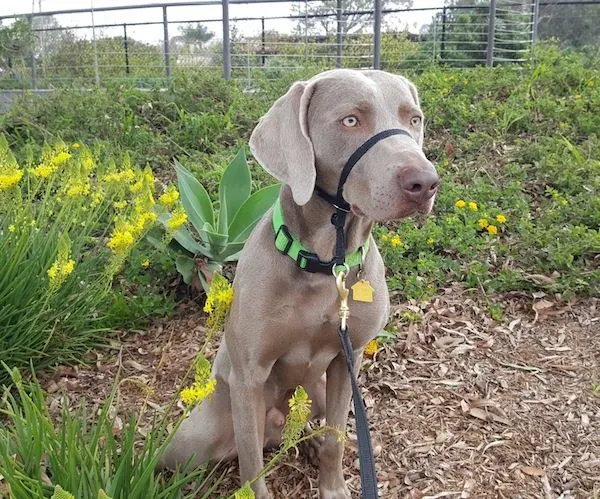
I use a Gentle Leader (Ace is modeling it on the right) when I want to help the dog calm down. It’s a good tool to use when I want to bring my dog along but might be preoccupied.
For example, if I’m walking my dog downtown while talking with a friend and holding a coffee in one hand, the Gentle Leader comes in handy. It allows me to “check out” a bit from dog training.
And don’t try to tell me I should never check out from training. We can’t always give all our attention to our dogs! The Gentle Leader allows me to relax and just enjoy spending time with my dog and a friend in busy situations.
Ace experiences some anxiety in the car, and the Gentle Leader has always worked to help him chill out a bit. The fabric around his muzzle calms him and puts him in a more submissive state of mind.
As another example, Cosmo was feeling stressed out at a recent dog show event we attended. He was barking at me and having difficulty settling down. When I put his Gentle Leader on him, he was able to lie down next to me and relax.
The Gentle Leader stops a dog from making those “choking” sounds
The Gentle Leader is also a good tool to keep my dog from pulling and making those “choking” noises.
Cosmo is a good example of a dog who practically strangles himself on a regular, nylon collar. He gets so excited, panting, pulling and “choking” that he causes other dogs to get very agitated as well.
When Cosmo wears a Gentle Leader, it eliminates his panting and choking noises by about 90 percent. He still breathes heavily, but it’s not nearly as audible. When he’s quiet, other dogs are less likely to react. Since Cosmo is still learning how to ignore other dogs during walks, anything that helps him give off a calmer energy is a good thing.
If Cosmo is calm and quiet on walks, then walks are much, much more enjoyable! That means he gets to go along on more walks!
What I don’t like about the Gentle Leader
The Gentle Leader puts too much pressure on a dog’s nose and eyes
Any collar can be dangerous if the dog pulls for an extended period of time.
The Gentle Leader is not a safe tool for extreme pullers.
Although the Gentle Leader is marketed as a humane option, it’s not always humane. When a dog pulls very hard for an extended period of time, the thin piece of nylon over his nose begins to put way too much pressure on him. When a dog pulls very hard, the Gentle Leader will slip to the side and put pressure on the dog’s face and under his eyes.
Dogs that are so focused on moving forward do not have enough sense to stop pulling, even if they are in pain. The pain might even cause them to pull harder, as they are trying to escape the pain. Excited dogs do not always know how to calm down and rationalize what is happening.
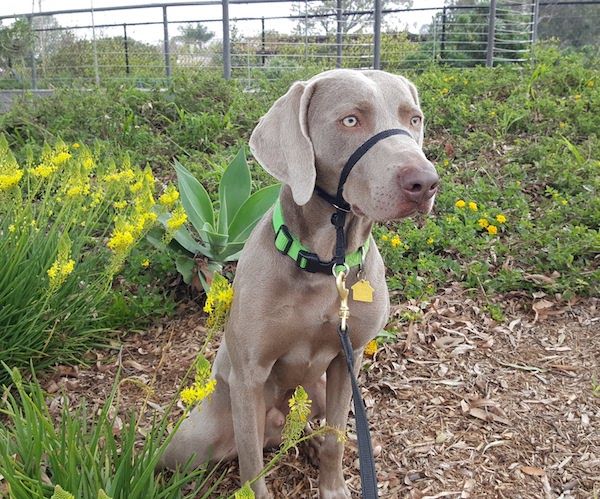
A few weeks ago, I took Cosmo for a longer walk than usual. He wore his Gentle Leader. When we came back, he was squinting his eyes for the rest of the night because of the pressure the Gentle Leader had caused. I was really worried I had permanently damaged his eyes. I was mad at myself for not stopping during the walk and switching to his regular collar.
Thankfully, bug-eyed Cosmo was just fine the next morning. Still, the incident was enough for me to re-think the Gentle Leader. Now I rotate which collar I use with Cosmo. For shorter walks, he usually wears the Gentle Leader. For longer walks, he usually wears the pinch collar.
And just for the record, the Halti is a similar tool to the Gentle Leader, but it’s designed better and typically doesn’t put too much pressure on a dog’s nose or eyes. It also has a safety strap that connects to the dog’s normal collar just in case he slips out of the Halti. For more info, check out my post comparing the Halti vs. Gentle Leader.
The Gentle Leader does not teach a dog to stop pulling
My other issue with the Gentle Leader is that it’s a Band Aid. It really is. Dogs learn not to pull as long as they are wearing the tool. But as soon as you remove the Gentle Leader, they go right back to pulling.
Cosmo is getting pretty good at heeling as long as he has the Gentle Leader on. Without it, he is a maniac. This defeats the purpose of a dog training tool. I know some dog owners are successful weaning their dogs off the Gentle Leader, but most people don’t bother to try. This is OK for a lot of people, but I expect more from my dogs.
This is why I use the Gentle Leader in some situations and the pinch collar in other situations. My goal is always to get to the point where no training collar is needed at all. From there, my goal is to achieve reliable obedience with no leash. Still, no dog is going to be perfect in every situation.
Some dogs hate wearing a Gentle Leader
Most dogs do not have any issues with a pinch collar, but a lot of dogs do not like having something over their nose. My mutt Ace pretty much shuts down at the sight of his Gentle Leader. His tail goes between his legs, he looks away, he lies down, and he cowers. Once he has the Gentle Leader on and we go for a walk, he is fine, but he still avoids me every time I get it out.
Now, if I have Ace’s pinch collar in my hand, he comes running! I’ve noticed this with other dogs as well. And some dogs really put up a protest, pawing at their nose and rubbing their face on the ground in an attempt to get the Gentle Leader off. The best thing to do is just ignore this behavior and continue on with the walk, but it’s not always easy to deal with a bucking, rearing, 80-pound dog.
You can’t give a dog a leash correction while she’s wearing a Gentle Leader
There are situations where I prefer to give a dog a leash correction for training purposes. The Gentle Leader is not designed for corrections. A good example of this is when I take Ace biking. Ace usually wears his pinch collar when I take him biking so I can correct him if he thinks about greeting another dog. The pinch collar is a good choice in this situation for the safety of myself, my dog and others.
Pinch collar for dog training (also called a prong collar)
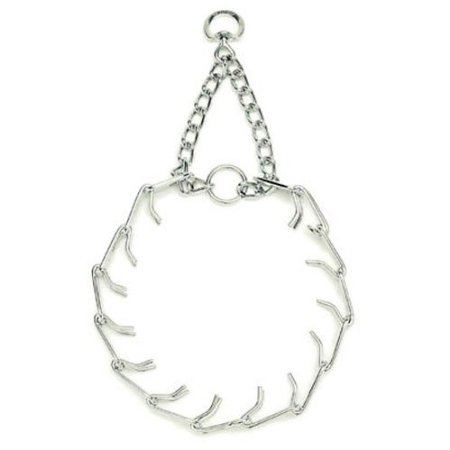
I’m really sick of this “positive reinforcement only” approach to dog training. The world is not all positive. Dogs growl and bite and pin one another all the time.
Parents are not always positive when teaching their kids something new.
Here’s an example:
My parents taught me to ride my bike by using training wheels and holding onto my bike while I pedaled. Eventually, they took the training wheels off. My parents knew I was going to fall and scrape my knees at least once. But eventually I learned how to ride my bike without falling. As a result, I got to experience more fun and freedom in my life. It also felt good to know my parents trusted me to ride my bike around the neighborhood by myself. But in order to get to that point, I had to fall a few times first.
It’s not always possible to go through life preventing those we love from experiencing a small amount of discomfort.
What I like about the pinch collar
The pinch collar allows you to give the dog a correction
If my dog is focused on a smell or another dog during a walk, all he needs is a quick tug on the leash to re-direct his attention. This is not meant to scare him or cause him pain. It’s not meant to make him feel inferior to me. It’s just a reminder to get him to focus on the task at hand – walking.
Usually Ace’s response to one of these tugs looks something like, “Oh, sorry. I got distracted.” I tug on his leash so gently that I believe it is actually the slight sound of the chain moving that gets his attention, not the sensation of the prongs on his neck.
The pinch collar will help teach a dog not to pull
The pinch collar fits around a dog’s neck like a normal, nylon collar. This makes it easy to eventually transition the dog from the pinch collar to a nylon collar.
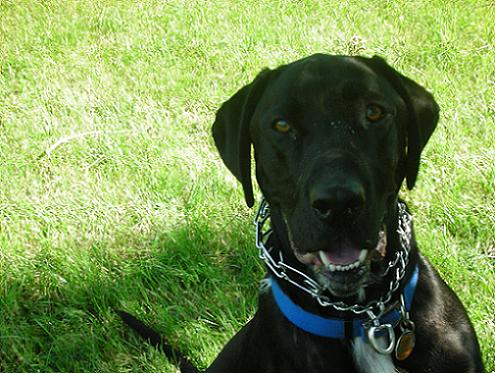
When I was teaching Ace to heel, I would have him wear his nylon collar and his pinch collar at the same time. That way I could switch his leash to one collar or the other as appropriate. For example, if Ace was walking nicely, I’d clip his leash to his nylon collar. If we saw another dog approaching, I would clip his leash to the pinch collar.
What I don’t like about the pinch collar
Sometimes the links on the pinch collar break apart
I’ve seen a few pinch collars come apart because one of the prongs was bent. This has happened to me and my dog. Luckily, Ace has no interest in running away. When his pinch collar fell off, he just stood there looking at me, like, “Well, aren’t you gonna pick that up?”
I am a bit nervous using the pinch collar with my foster dog Cosmo because he does not always come when I call him.
The pinch collar gets caught in long hair
Another reason I don’t like to use the pinch collar with Cosmo is because it doesn’t seem to work as well over his thick fur. It works better on Ace, who has very short fur. I’d like to hear some other opinions on this.
The pinch collar can hurt a dog if it is not used properly
It’s too easy to give aggressive corrections with the pinch collar. I cannot use a pinch collar on a dog unless I am calm and collected. If I am frustrated with a dog, I will be too tempted to give the dog harsh corrections. Causing fear or pain is not what the pinch collar is for.
I also see too many dog owners who do not use the pinch collar as a training tool. They just place it around the lower part of a dog’s neck and hope for the best. But the pinch collar is designed to be worn high on the dog’s neck, right behind her ears and under her chin. If the pinch collar is worn on the thickest part of the dog’s neck, it will be too easy for her to pull.
The pinch collar should be used as a tool to prevent pulling, not to make the pulling more tolerable for the human on the other end of the leash.
Sensitive dogs might overreact to a pinch collar
Cosmo yelped the first couple of times I corrected him with the pinch collar even though I was careful not to be too harsh. He was so sensitive that any correction at all scared him. He also reacted aggressively a few times by biting the leash. He will sometimes do this on his regular nylon collar as well.
This is why I started using the Gentle Leader with Cosmo, but after the incident with his swollen eyes caused by the Gentle Leader, I have started using the pinch collar again on longer walks. He is doing much better now that he’s used to it. He trusts me more than he did a few months ago, and his confidence is growing. He no longer has any issues with the pinch collar, and he doesn’t pull while wearing it.
Cosmo is pulling less with the Gentle Leader on as well, so I guess we are making some progress!
Other collars for dog training
Obviously there are dozens of different dog training collars. I only focused on two in this post. I’d love to hear your opinion on the option that works better for your dog – the Gentle Leader or the pinch collar. I’d also love to hear about any other collar or harness you use for your dog.
Which dog training collar is best for your dog?
Recent Search Terms:
- my dog is afraid of choke collar
- what is a pinch collar
- dog hates choke collars
- how to get a gentel leader on a scared dog ?
- how are gentle leader like horse halters
- pinch collars
- chain reaction collar leder


Regarding your comment that you do not like the pinch collar on Cosmo, a better option would be a “thin” choker. With this collar you are able to put it on and place it under the thick fur, making corrections more effective.
When working my first guide dog Luther, I needed to break out the gentle leader quite often as he would get very distracted around food, and it worked very well with him.
What do you mean by “thin” choker? Do you mean a higher-quality choke chain? I like using those for Ace, but Cosmo is good at slipping out of them. Again, it’s because of his thick fur.
Great information as always, very thorough. You should write a book.
And please include that you’re sick of the “positive only” approach. I’ve talked to a lot of trainers of police dogs and while they use mainly positive methods, they don’t always work with all dogs all the time. These trainers don’t have world enough and time and need to employ what works. The world isn’t always “positive” for dogs or any of the rest of us.
Thanks, Jan! I can’t believe there are any dog owners out there who haven’t, at least once, screamed “No! Bad dog!”
I agree about the positive only approach. There is no need for punishment, but sometimes negative “reward” needs to be used.
Love your blog and agree with your thoughts. Thanks for taking the time to share with us.
Thanks for reading!
I’ve only used the gentle leader with Charlie, he does shut down when I bring it out and he tries to get out of it but as long as we keep on moving there are no problems. I like to use the gentle leader with Charlie especially when I bring him to PetSmart or Petco because I like to be able to pull his head quickly away from any strangers who come a little too close. It makes me feel a little bit safer having control of his head.
Charlie used to pull until he choked himself but he actually completely stopped a week after using the gentle leader. I just took it off in the middle of the walk and he continued to walk right beside me without pulling, and I tried it on the next walk and he still didn’t pull, but that is probably not very common.
That’s why I like the Gentle Leader with Cosmo, too. I can pull his head away quickly if someone gets too close at the wrong time. That’s awesome that Charlie learned to walk nicely with and without the Gentle Leader. He’s a smart dog.
Lindsay:
Chokers, AKA choke chains come in various sizes as well as various degrees of thickness. The thicker the collar the less effective they are because the links that make up the collar are bigger, thus are unable to tighten as easily as links used to make thinner collars. The “zing” sound that comes from flicking the leash on a choker is usually enough to discourage unwanted behavior and this is much easier to get out of a choker that is thinner than it is thicker.
OK. That’s what I thought you meant, but just wanted to make sure we were on the same page. You’re right, there is a huge difference between a thicker choke chain and a thin choke chain. That “zing” sound you describe is exactly what discourages Ace’s unwanted behavior vs. the actual tightening of the collar.
Thanks!
We’ve tried everything from anti pull harnesses (worked for a while until I got used to it and started pulling again) to a sort of semi-check collar (nylon type collar with one part chain to allow corrections). The semi check collar ruined my short coat (its still not quite grown out) so now we’re back to the harness and my human trying to get me to turn around every time I pull. We’re not really making any real progress
I think my human is keen on trying the gentle leader as our local dog trainer also recommended it if all lead work training fails.
The Gentle Leader head collar usually works better for “extra strong pullers” compared to the anti-pull harness from the same company. So I hope it helps keep you in line, Alfie!
Well, as you know, we use a Gentle Leader for our golden on walks because it certainly calms her, which is important when we meet other dogs. She actually heels beautifully no matter what type of collar she wears, until we meet another dog. Hence the GL works out perfectly for us. She doesn’t care much for it, but hey, she gets more walks in with it!
Our springer on the other hand, is way more challenging on a walk and we do use a prong collar with her. I think maybe we’ve been using it too far down on her neck… will have to check this out further. She is not phased at all when we correct with it. The GL was not as effective with her, but I should probably try it again. I think mixing things up like you do/did with Ace might be wise.
Poor Ace never knows what collar I’m going to use – pinch collar, gentle leader, regular nylon collar, choke collar, no leash …
Yeah, definitely put that prong collar higher on Sophie’s neck. It has to be as high as it can go, where the neck is more sensitive. The correction does not need to be hard at all. A regular choke collar even works well as long as it’s very high on the neck. When I use a choke or prong collar, I stop and adjust it very often if the dog pulls.
The best collar we have ever used is the martingale collar that is half nylon half chain, you can’t choke a dog on these collars if fitted correctly, nor can they slip out of the collar. They also give the noise of correction when snapped out to the side correctly!
Jac Trac makes these collars
jactrac.ca/
Thanks for sharing your opinion!
Belle doesn’t like the Gentle Leader, she paws at her face and it seemed that no matter how short or long the walk was she was always squinting.
So I got a harness and its been working great! I’ve switched it up so she’s not wearing it all the time and she seems to be getting the idea that she doesn’t have to pull! It’s been wonderful!!!
Thanks for the post!! I don’t like the pinch collar because I see too many dogs just pulling against it.
The pinch collar is great if used properly. I’m glad you’ve found something that works for Belle.
Having used the prong collar on a dog that used to react strongly towards any moving animal (dog, squirrel, rabbit whatever) I found that it was not effective for her and actually increased the intensity of her reactions, steering her towards aggressive behaviour that she had not previously shown. If you’re thinking that I was probably using the collar wrong and hurting her, please don’t worry, as I was always as diligent as I could be about keeping the collar at the highest point on her neck and making quick, precise corrections. That being said, this dog had very sleek short fur and even the lightest correction of the prong collar would cause it to slip down her neck. I had a couple different trainers give me opinions on whether I had it too loose but all agreed it was as tight as it should be and it wouldn’t make a difference.
As for the gentle leader – it will only work on certain breeds of dogs because of their face structure. I currently have a boxer and there isn’t a Gentle Leader, Halti or any other similar model that I’ve found which will stay fitted to her face. This just isn’t an option with us.
We currently use the martingale collar (which someone else referred to, the nylon w/partial chain option) and have found that it is most effective. It still slips down on her fur but otherwise does the trick and prevents the need to switch back and forth between collars as it automatically loosens after corrections.
Thanks for your opinion, Meg!
My last dog had a will of steel. After a full year of intensive, daily training she could still not walk loosely on a leash. She understood exactly what she was supposed to do but just refused to do it. She also had a barking problem that could become scary to strangers. After a lot of thinking we decided to get a shock collar. I never thought I would use something like that- I have always used as much positive reinforcement as possible. But this is what THIS dog needed. After only two shocks she learned to associate the “beep” with the shock and I never had to shock her again. I could just beep her (tone only- no shock) and she listened like a charm. Within a few days something in her brain changed. She become a much happier, more relaxed dog and started respecting the rules of the household. It was amazing to watch our stressed out dog who would pull so hard that she would choke herself or bark so hard that people would be scared become a happy relaxed wiggling puppy again.
I do not think shock collars are for all dogs. I would never use one on my current dogs. They are both a lot softer and would be traumatized. But for a smart alpha dog who is dully trained but refuses to respect her humans and their rules- it did work.
Shock collars are definitely the right choice for some dogs in some situations when used properly, just like any collar. Thanks for sharing! I’ve seen shock collars help dogs relax and become happier, more balanced dogs as you’ve described.
I just bought a gentle leader for a dog in the rescue in boarding. I haven’t used one before, but Eli got to test it out. He wasn’t a fan of it the first couple times, but he got used to it
The dog I’m hoping to use it for is a lab mix who is basically a 60 lb puppy. She hates having things tight around her neck and will jump constantly and then alligator roll on the ground while kicking her legs in an attempt to get the tightness away. It’s a slippery slope. I made the mistake of trying a choke collar on her for more control…choke collars and alligator rolls don’t mix! If she was exercised daily I’m sure she would get more used to the leash and kicking and jumping at it wouldn’t be a way of getting her energy out. I’m excited to use it, I’m hoping it will give me more control and allow her more exercise time! I’m going to bring lots of treats to get her mind off of the collar. Wish me luck!
Are you referring to Tizzy? Let me know how it goes!
Yes, that would be Tizzy! I see you’ve heard about her. It did NOT go well at all. I ended up just taking the gentle leader off because she still pulled like crazy and did more alligator rolling than she did with her leash/collar. I might try a pinch collar next time I walk her because she is practically impossible to walk the way she is now. It seems that every time I see her she does better with fighting the leash, so I think the pinch collar might actually work now. She’s a very sweet girl, she just needs some better leash manners
Maybe one of those harnesses that stop the pulling? I had a feeling the Gentle Leader was not going to go well
Worth a try, though. I’m sure she just needs some time to adjust and also to burn off all that energy!
Loved your article! Finally a sensible write up about the prong vs a head halter. What I have found however is the opposite in one respect. I found the prong often calms a nervy dog, while a halti gives them that much more to spazz and be frantic about. One example that always comes to my mind in these comparisons is a client who’s dogs I trained a few years ago. They were two mutts, one of them a crazy spinny JRT mix the other a big lab mix that pretty much took his cues from the little guy. Based on the advice of a trainer, their owner always walked them using haltis as they both pulled, and both were very reactive and would have aggressive reactions to things like loud buses or other dogs walking by them. Anyways, long story short.. I put prongs on both and we went for a test walk, within 5 minutes both began to settle down and enjoy the walk and for the first time actually were able to pay some attention to their ower, she was amazed. Bottom line, they were both hyper reactive and defensive when wearing their haltis, their haltis caused them such serious anxiety (they were both anxious to begin with but just over loaded when wearing head halters) although this came about gradually enough that the owner never thought to blame the purely positive highly recommended tools, she just thought her dogs were getting worse on their own. They both did the crazy head rubbing, stop drop and roll mid walk, spin in circles and chase the bus, any tension on their face made them freak out even more. They were food motivated, but we couldn’t even get them interested in treats while they had their haltis on. They wore the prong, experienced a couple mild corrections, and that was about it. They started to take treats, they started relaxing for the most part as soon as the JRT mix began to relax, so did the big guy, and subsequently the owner, and of course the only got more relaxed as they realized the others were relaxed as well
I get what you are saying, and I’ve also experienced the same.
Cosmo has too much freedom to pull and freak out with the Gentle Leader on. I can’t calm him unless we just walk away, and then he’ll still try to pull and turn. With the prong, I can correct him and then he is able to relax on his own.
I haven’t noticed the Gentle Leader actually making Cosmo more hyperactive/nervous/aggressive, but that is something I will pay attention to. He’s a tough case for me, because sometimes he reacts aggressively to the prong by snapping at his leash after a correction, and I definitely want to avoid that.
I should find a regular choke/slip collar that fits Cosmo correctly. That’s probably they way to go for him.
Thanks for the info! Gives me something to think about!
Both of these collars can cause injury to dogs. (check out this informative site for more information on the dangers of collars: http://www.adogsview.net) According to that site, there are safer alternatives to both collars. Also it suggests training the dog to walk off leash so the collar doesn’t become the “trainer”.
Well I just finished reading your blog and agree that you have to use what works for you and your dog, however I completely disagree with all who are in favour of shock collars, I have witnessed a dog work through the degrees of shocks and still continue to react in a very negative way. Lets just say the handlers were in way over their heads and had no idea. It is a lazy dog owners way of actually not putting the effort into their beloved dog and actually getting some postive training! Yes I said it I am all for postive reinforced training. It works and why would we want our canines afraid of us that just opens up another type of training that needs to be done to undo the fear now we have put on our dogs. Back in the day we started using prongs on our shepards until we did more research and found that it was inhumane and not necessary. I am Pro- gentle leader!! 100% that as well as the anti-pull harness. I don’t reguire a thanks for your opinion either.
An e-collar is a humane tool when used properly, just like any other collar.
Hi Lindsey,
Just wanting to know the difference between a thick correction chain (choke chain) and a thin one?
Typically, the thinner the chain, the easier it is to give a correction because the chain will be smooth. When the links are larger, they tend to catch.
I recently discovered your blog and I think it’s great! Thanks for sharing your experience/expertise.
I am also a dog walker and have been walking a dog called Charlie for about two years now. Charlie is a rescue and no one knows what his early life was like, but he has some behavior problems now. His parents have paid lots of $$ for training, dog counselors, prozac, you name it. But still he is uber-aggressive towards other animals (literally he becomes crazed at the sight of another dog, raised hackles, pacing, aggressive peeing- seriously like to mark his territory, and if he gets close enough then it’s full on lunging/attacking). He displays similar behavior with big vehicles, making walks dangerous because he will, with very little warning, suddenly dart into the street. I saw him try to tear the bumper of an idling semi-truck once. The worst part is that he is completely non-responsive. He will not look at you, he will ignore food distractions… it’s like you aren’t there and he doesn’t know you.
This is turning into a long story, but the point is the the Gentle Leader was the only thing that made it safe to walk with Charlie. With other leashes he was able to lunge and throw himself into these flying arcs. He was hurting himself, I was always worried that he would slip out, and he would get so crazed that he would mix me up in his leash or knock me down. With the gentle leader he can’t do that. It has for the most part solved the issue with vehicles and greatly helped with keeping him under control when another dog comes into view.
For anyone trying to control an aggressive/non-responsive dog I would recommend the gentle leader. Even if the dog hates it at first they will get used to it! Charlie used to paw at it, rub his face on the ground, etc. Now he doesn’t mind at all and sits for you to put it on because he NEVER walks without it. He knows that the gentle leader = time for a walk, and so it’s cool with him
I’ve had the Gentle Leader dramatically help during walks with certain dogs as well. Some do not react well to a prong/pinch collar. They either don’t notice the corrections or the are aggressive to the corrections. The Gentle Leader or a Halti is a very valuable tool at times. I’m glad it’s helping for you and Charlie. He sounds like a handful!
I’m currently fostering an American Pit Bull that we think is about 6 years old. It’s pretty obvious the only thing her past owners taught her was “sit.” She expects to do what she wants when she wants. I’ve started obedience training with her and it’s going very slowly because she is so “leash reactive.” She gets excited, whines, and pulls around people and other animals. Walking her is very difficult. At first she pulled so much my arms were sore. Then I decided to try Gentle Leader (which I’m currently using). I’ve only had her for about 3 weeks so I know it will take patience and a lot of time. She pulls less and is much easier to manage, but still leads the walk. Her neck muscles are so strong that pulling the Gentle Leader doesn’t turn her head. It eases the pulling a lot but she stills looks straight ahead. I’ve also noticed lines on her muzzle lately where the strap of the Gentle Leader crosses because of her pulling and my constant corrections. A friend recently recommended the prong collar. My fiance and I are hesitant. The obedience trainer is against it. Another reason I hesitate is because I don’t want to have to use if forever. I was told that smart dogs usually always have to have it on walks because they know when they aren’t wearing it they can still pull. And I don’t want to have to use it all the time.
I really have to learn to keep her under control. We would love to keep her. She’s the sweetest dog I’ve ever had or seen. She has a wonderful temperment when off leash. But I own two cats and before I even start to introduce them I need to have complete control of her. Which I don’t right now. I realize I’ve just talked about several different things in my rambling but my biggest thing right now is do I go to the pinch collar?
Though the Gentle Leader is making the walks easier – she’s still leading. Or should I just be patient and see if with proper socialization and training eventually her walks will become easier.
There’s nothing wrong with using a prong collar. It works really well for some dogs. You do want to get one that fits properly though and adjust it so it’s always at the top of her neck under her chin and behind her ears. If it’s low on her neck she will be able to pull easier. The prong works well for some dogs and not others so I think you should just try it out and see if it works well for you or not. As far as dogs learning they can get away with pulling if the prong collar is not on, that is no different than the Gentle Leader. The goal should be to wean the dog off of whatever training collar you are using. Most dogs are able to figure out they can pull easier without a Gentle Leader on OR without a prong collar on.
I just walked a rescue pitbull today and I used a prong collar and she pulled so bad the entire time I was thinking a Gentle Leader would be better for her. She was so strong that the prong collar did not faze her one bit. So … just see what seems best for your foster dog. Sometimes it works just fine to rotate which collar you use, too. That’s what I kept doing with my American Eskimo foster dog.
Hello, we have been having a dilemma about which collar to use for Danny. He is a 1 & 1/2 to 2 year old german shepherd/collie mix rescue we adopted a few months ago & has pretty much only one issue. We have been trying to find a collar that works because his normal collar doesn’t work & the choker only kind of works. He can walk well for a few minutes but if there are any distractions (people, motorcycles, busses, other dogs) it’s back to square one & constant pulling & corrections. We live in a very busy area, so avoiding distractions isn’t an option.
We just started using the Gentle Leader & it does work to some degree. He isn’t able to pull anywhere near as hard & will walk beside me. He is no longer reactive to vehicles or people but other dogs are still an issue. I agree with what you said about wishing you could make corrections with it. He will still focus very hard & whine if dogs get close, but generally calms down alot faster with the GL. We have one neighbor that lets his dog run headlong into mine, even when I make a point of walking in the street to avoid them (has it on an 8 foot lead). When this happens Danny starts bucking, doing flips & basically turns in 60 pound flurry of barking, growling, fur & teeth until they have passed. I can tell that the collar hurts him when this happens, but he is so determined to get to the other dog he doesn’t care.
My father & his wife have been trying to convince us to try a prong collar for a while & this article has made me feel alot more comfortable with the idea. He does have pretty thick fur, so we’ll have to see effective it is. It’s possible that just using a better quality choker might work as well.
I think we will continue to use the GL for regular walks most of the time, but do some training with the prong collar & other dogs.
Other than walking he is pretty much perfect, has a very sweet temperment, is very good in the house & quite smart so we aren’t going to give up on this until we find a solution that works.
I would give the prong collar a try. Sometimes it’s nice to have a few options depending on the walk you will be going on. I try to use my dog’s regular nylon collar most of the time, but I will still bring out the choke collar, Gentle Leader or prong collar at times.
This is a lovely article, and it’s refreshing to find someone who encourages flexibility with regard to the types of collars used. I have a 9 month old GSD/Siberian Husky mix (we think) who is without a doubt the most headstrong and predatory animal I’ve ever had the pleasure of trying to train. She hasn’t yet progressed to barking or lunging as I managed to nip those before they became problems, however she is very apt to become overwhelmed by the smallest of stimuli. Leaves, bags, children, trash cans, you name it. Birds in particular will completely arrest her. She’s walked right into telephone poles, fences, fire hydrants, and even parked cars, all because she was too busy being utterly focused on a bird flying overhead.
It’s recently gotten better but worse, oddly. I communicate pretty well with her, and she knows she is not supposed to “focus” on anything in particular or she gets a correction. I can see her checking herself, which is marvelous, but sometimes she’s so conflicted about wanting to focus but fearing the correction, that she pinballs back and forth: her ears go wild, her eyes start rolling, and more than once she’s lifted off her front legs to bounce against me in frustration (which is a definite NO, DOWN). During these episodes I’m either standing like a tree and letting her pitch her fit, or actively demanding a sit/down; neither seems to work in the long term, and there are times I wonder if she’d rather just bite me and make a run for it.
We’ve been using a combination of a half chain martingale for normal walks, and a full chain slip collar for any situation that I know I’ll need the help. I don’t like the full chain as it slides down her considerably fleshy neck pretty much all the time, even properly fitted. The martingale is great until I need the force required to correct her most intense behaviors, at which point I feel like a mosquito scolding an elephant. I know that Haltis and similar designs can have a calming effect on a dog, but since a foster lab/pit broke the skin on her muzzle from lunging at a squirrel, I’m leery. Prong collars have always seemed an extreme method to me, and I can see their place, but I don’t think the extra stimulation would be the right direction for her; I could be wrong. I’d prefer to calm her down in the most direct way possible, and that might just end up being a well timed pinch from a prong.
I definitely think you should try the prong collar. You may not want to use it all the time, but it’s a nice option to have.
Amazing. That’s all I can say. We had an hour long walk tonight with our first prong collar, and it only took a few short moment for Dixie to chill out, walk slightly behind me (a first, since she’s usually sticking her head out and “toeing the line” of getting in front), and not want to jump on everything in sight. For the most part she corrects herself, and I only have to give the slightest little pull to bring her back in line. Still just a little twitchy, still wants to stare at things, but I have utter confidence that my days of fearing that she’ll take off are over. This article was what finally convinced me to buy a prong, so thank you. I can actually look forward to walks now!
Oh thanks so much for letting me know how it went. I thought you would like it. Prong collars are not as bad as they look. I am so happy your walks will be much more peaceful now. Keep up the good work.
i say the gentle leader stops pulling and jumping it dont hurt them i have a pitbull mix and he can pull me down the road. but when i put on the gentle leader he just stops pulling. but the pinch collar had killed a dog because the dog kept pulling and pulling so you should try the gentle leader
I am a dog trainer, and there are so many tools out there, and most are ineffective, or just plain bad.
I always elect to use a Canny Collar, and my clients with extra strong pullers agree. (I usually teach to walk straight away on a standard collar, but some benefit from gaining confidence with the Canny first.) It is different to all other headcollar types, and by far the best design. It works by pulling the nose down, not twisting the neck. It attaches at the back of the head, and sits high. It rarely rubs (only if used incorrectly). You dont have to walk on a certain side like some brands. BUT best of all, it corrects the walk. It teaches not to pull, and it actually converts into a standard collar, so when taught, no need to buy another collar!
I do not ever suggest a harness, as they put the point of leverage over the dogs whole body, thus making them stronger.
I never use a harness either. Some people prefer those Gentle Leader EasyWalk harnesses though. They do work to stop the pulling. They are just not the tool I prefer to use. I will look into the Canny Collar you mentioned.
I cant get my 5month old husky from biting when i try to put his gentle leader on. He flumps on th floor, ears back and looks sad. But when i get it out he bolts and shows his teeth when i go anywhere near his nose with it. Please help
Hi Laura,
Sounds like you have some dominance issues with your husky boy. At 5 months he certainly shouldn’t be challenging you, but as his hormones begin to kick in, he’ll be challenging you more and more.
He needs you to be very firm and be in the dominant role ASAP, as this will only get worse as he matures. You may find a proffessional trainer best to help you gain control again. Another measure that would be very much advised with a dominant male is to have him neutered at 6 months. There is debate about neutering as young as 6 months, and i’d advise discussing with our vet, but above the year mark and it has little effect on dominant males.
Laura, your dog sounds like he is a bit fearful of the Gentle Leader and not necessarily dominant. But I assume you need it in order to control him easier on walks. You could try putting it on him once you are already outside. Just start the walk with his regular collar and then slip the Gentle Leader on outside once you are on the driveway or outside the door and he is likely in a different state of mind. Keep it positive. Give him treats when he’s relaxed and well behaved. Just keep on walking if he starts thrashing around and give a firm “NO” if needed. Mostly, just keep on moving forward so he has to follow.
My dog hates his Gentle Leader as well. He does not show aggression, but he gets very, very submissive and shuts down like he is depressed when I get it out. You may want to think about using a prong collar instead, or at least give one a try to see if it works better. My dog doesn’t mind the prong collar at all.
I’ve been reading your blog and appreciate the advise on the prong collars and Halti Harness…I have two rescue dogs- a Parsons Russell mini Poodle mix and a Chihuahua, Scottish Terrier mix, if you can believe it! The problem with both of them is aggressive behavior on walks to anything moving, be it human, animal, mechanical or anything with wheels. I’ve tried the halters and liked them but it doesn’t really solve the problem. I’m now using a pinch collar on Wally, the Scottyuahua, because he’s the biggest instigator. He seems fine with it but will know better when we go for our next walk into the real world. I’m just so tired of looking like, and probably am, strangling my animals all the time…otherwise, great dogs.