In this post, Lindsay shares her tips on how to introduce dogs. Then, at the end of the article, Barbara shares her experience introducing a large dog to a small dog.
Lindsay here! A few months ago I took a dog to an adoption event. The dog I handled was an American pit bull terrier named Jesse. I was careful when introducing him to new dogs, because we weren’t sure how he would do.
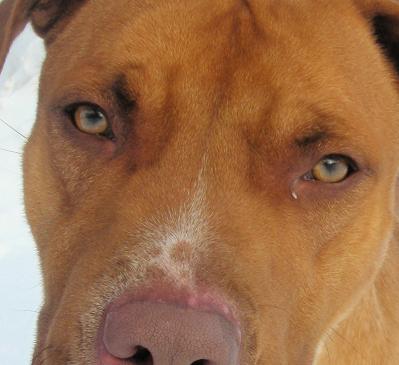
Jesse is pictured below and was adopted. He was a very good boy at the adoption event and did not cause any problems.
Still, I was amazed by how careless some people were when introducing their pets to Jesse and the other rescue dogs. So many owners did not keep their dogs under control. A barking, lunging lab strangling itself on a buckle collar is going to cause problems even if he’s “friendly.”
There were a couple instances where owners would allow their extremely hyper and out of control dogs to pull right up to Jesse head on.
Since I was paying close attention and predicting these situations, I was always able to redirect Jesse so he wouldn’t try to match the other dog’s energy. That’s when a situation can easily escalate into aggression from either or both dogs.
Humans meet face to face with eye contact and a handshake. Naturally, this is how we tend to introduce dogs to one another.
When friendly, socialized dogs are introduced face to face, they usually manage to be OK. They are not necessarily comfortable, but they deal with it.
Problems occur when one dog is too excited or has any issues with leash aggression. That’s when head-on greetings can lead to problems. (My weim Remy greets dogs with way too much excitement. This often brings out aggression as other dogs tell him to “knock it off.”)
Luckily most dogs will be OK no matter how bad the humans screw up the greeting process. But here are some tips for introducing two dogs when one or both could have some issues with aggression or fear.
Tips for safely introducing two dogs – How to introduce dogs
1. Exercise both dogs separately before they meet.
It depends on the dog, but a good 45-minute walk is ideal for most. Dogs with any kind of aggression issues should be walked for an hour or more before meeting another dog. The same goes with shelter or rescue dogs that have been kenneled for days or weeks.
I ran with Jesse before the adoption event, and another volunteer had walked him earlier in the morning so he was good and tired before meeting other dogs. The less energy the dog has when it meets another dog, the better. Even though my mutt Ace is low-energy, I almost always take him for a walk before he meets a new dog so he doesn’t bring extra excitement to the situation. (Update: Sweet Ace has passed away.)
2. Walk the dogs together.
This is sometimes impossible to do if neither dog has had enough exercise. That’s why exercising the dogs separately first is a must. Then you can walk the dogs together as a group.
Do this before you allow the dogs to smell one another. Keep one dog on each side of you or walk side by side with the other person. Don’t allow the dogs to cross in front or behind you. After a short walk, then you can allow some casual sniffing but keep moving forward.
3. Let the dogs smell one another.
After a short walk (5 to 20 minutes) with no issues, stop and let the dogs smell one another if they have a history of doing well with other dogs. Don’t worry so much about the embarrassing behaviors dogs do like butt sniffing. It’s usually best to let the dogs do their thing.
4. Learn to read dog body language.
I often watched Ace’s tail when we were out on walks. Normally when he was in a relaxed, working mode, his tail would also be relaxed and low. But when he saw another dog, his tail went up. This didn’t signal aggression, but it signaled he was in an alert mode.
More “submissive” (I’m careful to use that term) or insecure dogs will have their tails lower or tucked between their legs, often wagging frantically. Dogs about to show aggression might have their tail stiff and straight out.
After meeting another dog, Ace would also shake his whole body as though he’d just gotten out of a lake. This showed he was ready to move on, as though he was saying, “What’s next?” It’s kind of like letting out a sigh of relief after I meet a new person. The tension is gone and we can move on.
The most obvious sign of a playful, friendly dog is when he does a “play bow.”
Another common behavior is for the dog to just walk away and smell the grass or focus on something else. After Ace met another dog, he usually proceeded to walk away and pretend to sniff something. This “lack of interest” showed the other dog he was not a threat.
As for signs of aggression, watch for stiff body posture, fixated eyes, curled lips and raised hair, although these don’t necessarily always mean “aggression” on their own. Raised hackles can simply be excitement, for example.
5. Use appropriate training collars.
Having control over the situation is very important. A lunging, pulling, panting lab on a buckle collar will be hard for anyone to control. Sometimes a choke collar helps, but only if it’s used properly and stays high on the dog’s neck. A martingale training collar is another option.
Most dogs are easier to handle on a Gentle Leader or pinch collar, which is what I usually use for a new dog. A dog Gentle Leader or Halti often has a calming effect on a dog for some reason. Ace sometimes wears his Gentle Leader in new situations for this reason.
6. Avoid small spaces.
Dogs are more likely to snap if they feel trapped and have nowhere to run. This is why simply being on a leash brings out more aggression in some dogs. You also want to prevent one dog from cornering the other. If the dogs meet in an open area like a park, this shouldn’t be an issue.
7. Remain calm.
Don’t use an excited voice. In fact, don’t talk to the dogs at all. Talking gets them excited, and you want to have two calm dogs. At the same time, don’t allow too much tension in the leash. It will just make the dog resist you and pull away. It can also make the dog feel tense and more likely to lash out.
8. Introduce the dogs on neutral territory.
Dogs are territorial and can be possessive. It’s a bad idea to introduce them in a home or yard where one lives. Instead, introduce them in a park or parking lot where neither dog will find it necessarily to guard or protect “his” territory.
How not to introduce two dogs:
1. Don’t allow one dog to cower near you.
If one dog is insecure and using you as a guard or shield, keep moving. This is not cute behavior, it’s insecurity or possessiveness. You don’t want a fight to end up beneath or near you because you could be nipped.
2. Don’t allow dogs to guard you.
Often, one dog is possessive over the owner and the owner doesn’t even know it. I foster dogs and used to offer pet sitting. Almost every time I had a new dog in the house, it tried to place itself between Ace and I. When you are introducing dogs, keep moving and be aware of signs of possessiveness over you!
3. Don’t use an excited voice.
You want to calm the dogs, not rile them up.
4. Don’t create tension in the leash.
Dogs pick up on our posture and body language more than we realize. Tension in the leash or in your body posture will only make the dogs feel tense. Be relaxed so they will also be relaxed.
5. Don’t overreact.
Thankfully, if an unfortunate fight does happen, it will usually look and sound worse than it is. Usually the dogs will move on right away, especially if the people don’t over react. If things aren’t going well, try walking the dogs parallel some more or re-grouping on another day.
6. Don’t let the dogs approach head on.
When I had Jesse at the adoption event, I made sure not to allow other dogs to approach Jesse head on. I always redirected Jesse’s attention to me instead or we just moved away.
7. Put away all food and toys.
Don’t have anything available that could cause possessiveness or a fight. I’ve seen Ace act possessive over a water bowl!
Avoid fights by putting anything away that could cause a dog to be possessive such as a tennis ball, raw hide or even a dog bed.
How to introduce a small dog to a big dog
That Mutt’s writer Barbara recently introduced her friend’s newly adopted dog to her own dogs. She’s going to share her tips and how it went!
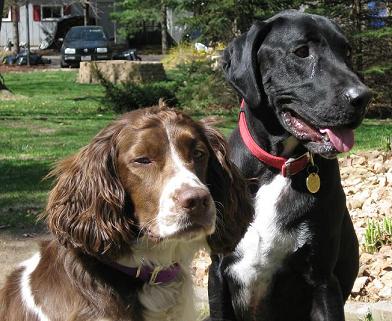
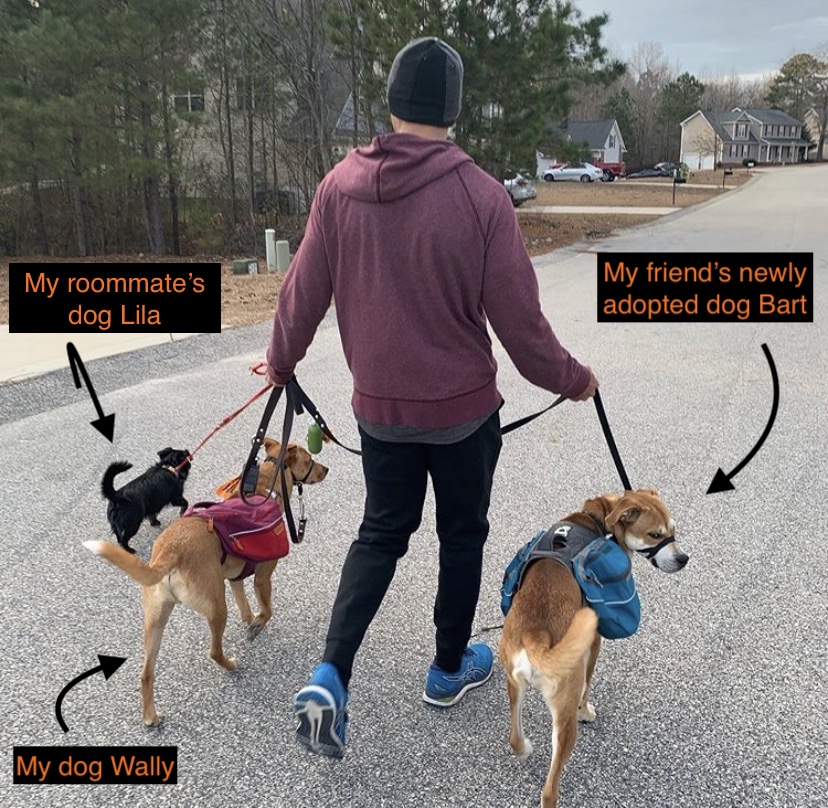
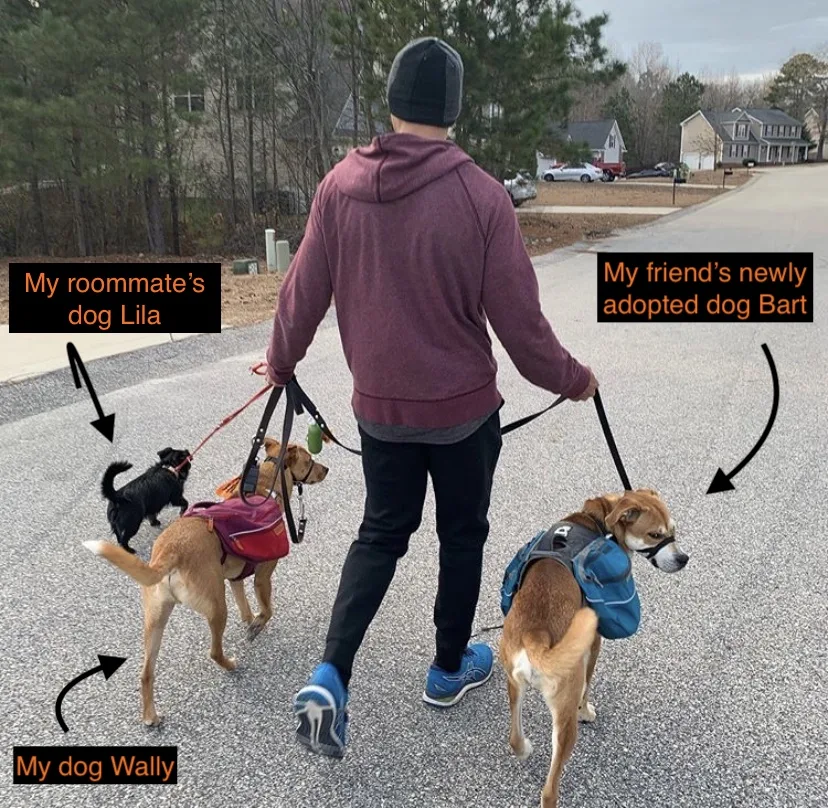
Hi, Barbara here! The picture below shows the ultimate outcome of slowly introducing Pekingese mix Lila, Feist mix Wally, and Lab mix Bart. They were very excited around one another the day they all met, but now they’re able to calmly walk together.
This was not the case at the very beginning, and it took about three days to get to this stage. Let me talk to you about how we got everyone on the same page!
Day 1: How Lila, Wally, and Bart met for the very first time
In preparation of meeting Bart, Lila and Wally went for a walk with me, then we hopped in the car and went to my friend’s neighborhood. Before we arrived, he had taken his new dog Bart for a walk and played with him.
Once we got there, I leashed Lila and Wally and slowly started walking away from my friend’s house. He then came out with Bart on his leash and slowly started following us. Wally and Bart both wore their head collars but no backpacks.
So far, so good, but only about two minutes into the walk both Wally and Bart started acting up since hey had noticed one another! As a result, Bart began to pull on his leash and Wally kept looking back in Bart’s direction, started to wine and bark, and decided it was time to start jumping into the air! It’s his thing whenever he gets super excited.
I was able to quickly correct him by shortening my leash and telling him NO once in a firm voice.
Of course that’s when Lila decided to take a poop in someone’s front yard. My friend and I both took a deep breath and he turned back around with Bart and began walking him in circles. He did that so that Bart would stop pulling and focus on his handler rather than the other dogs and human ahead of him.
Long story short, we walked for another 30 minutes and Wally and Bart began calming down, to the point where we were able to all walk next to each other in one line. However, Lila and Bart could not walk next to each other quite yet because Bart was overly interested in pawing her!
Our initial walk was followed by supervised backyard time
After this initial walk, we proceeded to go into my friend’s backyard and let the pups run around off leash.
Wally and Bart sniffed each other politely and did some play bows and raced around together. Lila however wasn’t comfortable because Bart was overly excited around her and kept pawing at her, so we took her inside my friend’s house. We ended up letting Wally and Bart play for about 30 minutes, then Wally, Lila, and I were headed back home to my place.
Day 2: More walking followed by supervised playtime. Enter the spray bottle.
We all met up again the next day, this time at my place. We went for another 45 minute pack walk that went ok, but Bart was still very easily excitable and tried to jump onto Lila while we were walking.
The pups had more playtime in my yard after our walk, and this time I brought out a spray bottle filled with water and apple cider vinegar so that Lila could stay outside with us as well.
Since Bart was pretty annoying around her, I gave him a good spray every time he came too close to her, and that ended up working. What I didn’t want to do was pick her up and carry her around. That would have increased his excitement and made him likely to jump onto me and her, hence the spray bottle approach.
After this play session, we decided to bring everyone inside. I kept the spray bottle nearby to correct Bart whenever he wanted to pounce on Lila. This happened a few more times. I’m not entirely sure why, but it probably had to do with their different energy levels.
Lila is a distinguished little pup who’s 8 years Bart’s senior, and Bart is an overly exuberant young dog who just got out of the shelter. Maybe her small size also activated his prey drive.
Day 3: Bart gets a job. Enter the backpack.
My friend, Bart and I met up again the following day and took a little drive to a pet store in Cary, NC. I had the feeling that Bart needed a backpack to help him calm down and redirect his excess energy into the job of carrying weight.
It’s what I did with Wally the day I adopted him and it has worked out beautifully. Bart tried the empty backpack on inside the store and we walked him around in there through all the different aisles. Let me tell you that the backpack made a huge difference in his excitable demeanor, even though it was still empty!
That day we ended up going for several walks and Wally and Bart both wore their respective backpacks.
The job of carrying weight drastically reduced Bart’s desire to want to pounce onto little Miss Lila, and we were able to go for structured, calm walks. I still don’t trust him 100% off-leash around Lila, so for now the spray bottle remains close by whenever all three pups hang out.
Crates and/or baby gates
We had a few sleepovers at my place in December when my friend watched the pups for me when I had to work. Both Wally and Bart were crated separately in my room so there wouldn’t be any jealousy or conflict over who gets which spot on the human bed.
The pups got bully sticks while they were crated and did phenomenally well in their crates at night. When their crates weren’t being used during the day, the doors stayed shut to avoid any potential drama involving one pup walking into the other’s crate.
Lila also got some downtime in my roommate’s bedroom when Wally and Bart were loose inside the house (always supervised). We put a baby gate in the doorframe so that the door wouldn’t need to be closed. We didn’t want her to feel left out after all. Bart came up to the baby gate multiple times but always respected it and didn’t try to jump it.
Feeding time in separate areas
We created an “invisible triangle” of sorts at feeding time.
Wally and Lila are used to eating at opposite sides of the kitchen, and Bart ended up eating his meals in the living room.
As soon as everyone was done with their food, all bowls were picked up to avoid any possible fighting over (perceived) leftovers. If you’re having difficulty creating a calm environment at meal time, you could also feed your pups in their crates or use baby gates to create separate spaces.
Recap of all the tools we used :
Backpacks for Wally and Bart. I swear by backpacks for higher energy dogs and/or those who are still working on polite leash manners. Backpacks make them less prone to acting up because they give them a job to do by carrying physical weight and focusing on the pack they’re carrying.
Halti head collars for Wally and Bart. Head collars give the handlers a lot of control over their dogs. They’re able to gently redirect their attention away from distractions and keep the dogs’ focus on the handler.
6 foot, non-retractable leather leashes for every dog. Leather leashes are sturdy yet gentle on our hands, which make them one of my favorite dog walking accessories. Retractable leashes are a no-go for me on walks because they offer little control and can seriously hurt yourself and your dog when you get tangled up in them. That being said, I do use them for recall training purposes.
Spray bottle filled with water/apple cider vinegar mix for a quick, effective correction.
Crates at night and/or baby gates during the day. Essentially for as long as you don’t trust the dogs together and whenever you can’t actively supervise. That Mutt’s sponsor, Carlson Pet Products, has a variety of crates and gates.
Yes, walking the dogs together is a very good idea. I would choose a "neutral" area, not ones home where one dog may get territorial. Both dogs should be walked in a "Structured" fashion, which means each dog is totally controlled by a separate handler, structured means no sniffing, marking, lunging,barking, walking at heel. Use training collars if the dogs don't walk well on lead. This shows both dogs that the humans are in charge of the pack, and are making the decisions. The dogs should look to the handlers for information. Stay calm. I like a 45 minute walk total, after a few minutes if the dogs are calm try walking past each other, then back together in the same direction. Dogs do NOT need to meet each other face to face. Packs of dogs both domestic and wild move together, it bonds them as a group.
steven
Sunday 15th of April 2018
I found this to be an excellent article. My only criticism would be the use of choke or pinch collars as they can do damage to the dog even if you supposedly know how to "use them properly"
Rosie O'Connor
Thursday 12th of April 2018
I wish I saw this post when I first got my rescue Shepherd! We went to the pet smart training (did not work for my dog and I at all! We found another place that I feel comfortable with now.) and I already knew my dog had some sort of leash aggression or had a hard time meeting dogs on a leash. But with the point that you mad with not meeting other dogs head on was EXACTLY how all the dogs at the pet smart tried to meet my dog. The trainer there was not helpful and basically said to let them meet nose to nose and it was my negative energy causing my dog to lunge, bark, growl and pull up how hackels. Now I know that I should have NEVER put my dog in that situation in the first place. I’ve learned a lot since moving to another training facility and the biggest trigger for my dog is meeting nose to nose on a leash. He is now CGC certified and is working towards his urban CGC. I really wanted to emphasize your point to not meeting nose to nose, even if the other dog is great with it. Don’t make assumptions! Thanks for this post!
Lindsay Stordahl
Thursday 12th of April 2018
Rosie, congrats on working towards the CGC test. That is great progress!
Brittany
Sunday 30th of August 2015
I have a question I have a 6 month old pit. That has latched on to two dogs ears and won't let go. How do we break him of this behavior? He is fine with our other two dogs but doesn't not like my brother in laws dogs.
Lindsay Stordahl
Sunday 30th of August 2015
Is this a "playful" behavior or an aggressive behavior? It sounds aggressive to me, but I don't know the details. Have you tried taking the dogs on a long walk together and letting them sniff and interact a bit during and after the walk? After that, if all seems to be going OK, you could have the dogs together in the house or yard but on leashes. Maybe avoid the off-leash play/excitement and encourage calm behavior like lying on dog beds with leashes on.
blair
Friday 24th of October 2014
I recently adopted a pomeranian from a local shelter. He's a really great dog and listens very well! If we're on walks I can call him and have him sit and listen to me and he catches onto what I want very fast. When we first brought him in, walks were terrible because any kind of dog at any distance sparked a reaction in him. Behind fences, across the street, in front of us, anywhere that there was a dog he'd growl and bark and lunge at them. One time he got off leash and chased a dog through the park nipping at it's heels and even biting off bits of fur, I'm glad the other dog wasn't aggressive but it was a really terrifying experience seeing him bolt after a large dog. Over the past two months I've been putting him on his back when he growls or barks at other dogs and so far this has had amazing results, it calms him down and I can quickly let him up and correct the behaviour. Dogs behind fences don't matter to him at all now and he can easily walk by them even if they are lunging and growling at him with no problems. He's been able to get somewhat close to them without reacting but I still have to keep a close eye. Sometimes if theyre barking at him he freezes up and can't move unless I gently call him and lead him away. Dogs across the street and in the park that are far enough away he won't react to either, he'll easily leave looking at them if I call his name. However meeting dogs and crossing them on the same side of the sidewalk is still an issue. He's been unable to walk by a dog on the sidewalk without growling and too often people let their small dogs wander about offleash and I'm afraid he'd hurt them or get in a fight with a large dog and be really hurt. I'm wondering if you have any advice as to how to help him? My friend has a very well socialized lab I'm hoping to introduce to him in November and we're thinking of using this article to help do that, I just want to keep training him correctly so it doesn't end up a mess!
Lindsay Stordahl
Friday 24th of October 2014
I'm glad you have made some progress. I would suggest walks with calm dogs like your friend's dog. Walk them side by side with some distance at first so there is no pressure to interact. It sounds like your dog may be fearful of other dogs, correct?
I like the book Feisty Fido by Patricia McConnell. She writes about listing out your dog's "triggers" and then working at the point just before your dog will react, using treats. So, if your dog reacts to dogs from 10 feet away but is good with dogs at 15 feet away, you would want to practice being around dogs at 12 feet. Use treats to distract her and reward good, calm behavior. I realize it's hard to find "real life" scenarios where you can practice this, but maybe your friend's dog will be helpful.
Here are a couple links to some similar posts you may want to check out:

Kim Chappell
Thursday 27th of December 2018
Yes, walking the dogs together is a very good idea. I would choose a "neutral" area, not ones home where one dog may get territorial. Both dogs should be walked in a "Structured" fashion, which means each dog is totally controlled by a separate handler, structured means no sniffing, marking, lunging,barking, walking at heel. Use training collars if the dogs don't walk well on lead. This shows both dogs that the humans are in charge of the pack, and are making the decisions. The dogs should look to the handlers for information. Stay calm. I like a 45 minute walk total, after a few minutes if the dogs are calm try walking past each other, then back together in the same direction. Dogs do NOT need to meet each other face to face. Packs of dogs both domestic and wild move together, it bonds them as a group.
steven
Sunday 15th of April 2018
I found this to be an excellent article. My only criticism would be the use of choke or pinch collars as they can do damage to the dog even if you supposedly know how to "use them properly"
Rosie O'Connor
Thursday 12th of April 2018
I wish I saw this post when I first got my rescue Shepherd! We went to the pet smart training (did not work for my dog and I at all! We found another place that I feel comfortable with now.) and I already knew my dog had some sort of leash aggression or had a hard time meeting dogs on a leash. But with the point that you mad with not meeting other dogs head on was EXACTLY how all the dogs at the pet smart tried to meet my dog. The trainer there was not helpful and basically said to let them meet nose to nose and it was my negative energy causing my dog to lunge, bark, growl and pull up how hackels. Now I know that I should have NEVER put my dog in that situation in the first place. I’ve learned a lot since moving to another training facility and the biggest trigger for my dog is meeting nose to nose on a leash. He is now CGC certified and is working towards his urban CGC. I really wanted to emphasize your point to not meeting nose to nose, even if the other dog is great with it. Don’t make assumptions! Thanks for this post!
Lindsay Stordahl
Thursday 12th of April 2018
Rosie, congrats on working towards the CGC test. That is great progress!
Brittany
Sunday 30th of August 2015
I have a question I have a 6 month old pit. That has latched on to two dogs ears and won't let go. How do we break him of this behavior? He is fine with our other two dogs but doesn't not like my brother in laws dogs.
Lindsay Stordahl
Sunday 30th of August 2015
Is this a "playful" behavior or an aggressive behavior? It sounds aggressive to me, but I don't know the details. Have you tried taking the dogs on a long walk together and letting them sniff and interact a bit during and after the walk? After that, if all seems to be going OK, you could have the dogs together in the house or yard but on leashes. Maybe avoid the off-leash play/excitement and encourage calm behavior like lying on dog beds with leashes on.
blair
Friday 24th of October 2014
I recently adopted a pomeranian from a local shelter. He's a really great dog and listens very well! If we're on walks I can call him and have him sit and listen to me and he catches onto what I want very fast. When we first brought him in, walks were terrible because any kind of dog at any distance sparked a reaction in him. Behind fences, across the street, in front of us, anywhere that there was a dog he'd growl and bark and lunge at them. One time he got off leash and chased a dog through the park nipping at it's heels and even biting off bits of fur, I'm glad the other dog wasn't aggressive but it was a really terrifying experience seeing him bolt after a large dog. Over the past two months I've been putting him on his back when he growls or barks at other dogs and so far this has had amazing results, it calms him down and I can quickly let him up and correct the behaviour. Dogs behind fences don't matter to him at all now and he can easily walk by them even if they are lunging and growling at him with no problems. He's been able to get somewhat close to them without reacting but I still have to keep a close eye. Sometimes if theyre barking at him he freezes up and can't move unless I gently call him and lead him away. Dogs across the street and in the park that are far enough away he won't react to either, he'll easily leave looking at them if I call his name. However meeting dogs and crossing them on the same side of the sidewalk is still an issue. He's been unable to walk by a dog on the sidewalk without growling and too often people let their small dogs wander about offleash and I'm afraid he'd hurt them or get in a fight with a large dog and be really hurt. I'm wondering if you have any advice as to how to help him? My friend has a very well socialized lab I'm hoping to introduce to him in November and we're thinking of using this article to help do that, I just want to keep training him correctly so it doesn't end up a mess!
Lindsay Stordahl
Friday 24th of October 2014
I'm glad you have made some progress. I would suggest walks with calm dogs like your friend's dog. Walk them side by side with some distance at first so there is no pressure to interact. It sounds like your dog may be fearful of other dogs, correct?
I like the book Feisty Fido by Patricia McConnell. She writes about listing out your dog's "triggers" and then working at the point just before your dog will react, using treats. So, if your dog reacts to dogs from 10 feet away but is good with dogs at 15 feet away, you would want to practice being around dogs at 12 feet. Use treats to distract her and reward good, calm behavior. I realize it's hard to find "real life" scenarios where you can practice this, but maybe your friend's dog will be helpful.
Here are a couple links to some similar posts you may want to check out:
http://www.thatmutt.com/2014/01/27/dog-training-stop-my-dogs-excitement-around-other-dogs/
http://www.thatmutt.com/2014/06/10/5-tips-for-managing-a-leash-reactive-dog/