Note: This is a guest post by Ty Brown. Ty runs CommuniCanine, a dog obedience and behavior modification business in Utah. He also owns and operates the web site Dog Behavior Online which is full of dog training tips and resources.

I get a lot of flak for this in the dog training community, but I am not a fan of the Halti, Gentle Leader and No-Pull Harnesses. I am currently raging a war of one against these training tools and am losing ground quickly. No worries, though. Like the captain that goes down with the ship, I’ll continue my fight until the bitter end.

In my battle on these training tools I come fully armed with ammunition.

My war on the Halti/Gentle Leader

1. I see these tools as a gimmick.

They rarely teach the concept of proper leash walking. Rather, they tend to teach the dog not to pull while the gimmick is on. There is very little technique used with these tools. For that reason I think of them as a band-aid. They cover up the problem but do very little to fix it.

When I am helping a client teach his or her dog to walk on a loose leash, I use training tools such as a pinch collar, flat collar or slip collar. With those collars, though, I teach my clients a great deal of technique. Technique is what teaches the concept of how to walk properly on a leash and what allows that owner to eventually wean the dog off the training collar. When someone depends on a harness or head collar to walk properly, then the owner is forever tied to that implement and the dog has essentially never learned to walk on a loose leash.
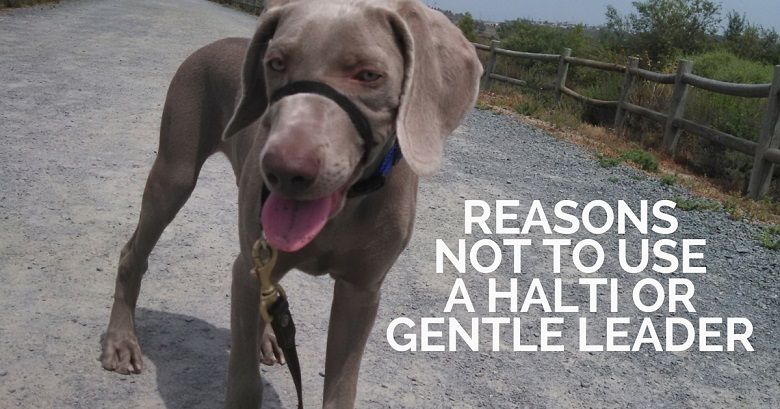
I’m sure there are those who have weaned their dogs off the head halter but they certainly did so using a great deal of technique. Most people will find themselves forever attached to a tool.

dog-gentle-leader

2. Haltis and Gentle Leaders are often very uncomfortable and distract the dog from the task at hand: walking!

If I had a nickel for every time a client complained that her dog wouldn’t stop itching at his face and head, scraping his face against the ground or going into a death roll to try to get the material off his head I’d have enough for a meal at McDonald’s – supersized!

A training tool should be like an accessory. It should be a normal thing to which the dog doesn’t pay attention. Many dogs find it hard to ignore a mesh of nylon all over their faces.

3. Head harnesses can worsen aggression issues.

Dogs create associations with the actions they are currently involved in and what they are currently focused on. Dogs that have aggression issues are prone to lunge at the objects of their aggression. In the act of lunging it can be very difficult to control a dog if they are on a head or body harness. Not only that, but picture what the dog is experiencing. All of his focus is placed on the target of his aggression when suddenly his neck gets twisted from the lunge. Many dogs are prone to associate that pain in their neck with the object of their aggression and therefore the aggression becomes worse. Many dogs will feel that the object of the aggression caused their pain and therefore they end up having worse feelings for the other dog, person, etc.

I have given several reasons why I am battling these harness style collars. I’m sure there are those who are able to avoid these pitfalls with their training techniques. My experience shows, however, there is a much better way.

Whichever training tools you use with your dog, make sure that you are using them in a humane fashion and ensure they are used as teaching tools rather than punishment tools.

Happy training!

Check out my interview with Ty on protection dogs and his post for That Mutt on the rottweiler.

Related posts:

  1. How to introduce dogs

That Mutt Ebook

24 Responses to “Reasons not to buy a Halti”

  1. Apryl DeLancey Says:

    I’m not a fan of the Halti either. I know many people swear by it but it just isn’t for me.

    I think it’s great that you have a guest post up about something that looks to be different than your own opinion. Thanks for bringing all sides of dog training and obedience!

  2. Missy Collard Says:

    I would listen to what Ty said.

    He helped me train my dog to walk on a leash. He knows what he is talking about. Besides teaching your dog to walk on a leash is a building tool to other commands and good behavior.

    Thanks Ty for being our Captain.

  3. Maggie Says:

    When I adopted my dog Emmett, he had never walked on a leash, so his instinct was to drop low to the ground and pull as hard as he could! We tried an array of products, including the halti. I switched him to a limited slip collar and added the “watch me” command, and we’ve had very pleasant walks ever since!

  4. Bonnie Story Says:

    A friend tried the halti on her St Bernard mix and found that people were terrified of the dog – the halti came across as a muzzle to the uninformed! So it lead to some dirty looks and tedious Q/A sessions. She she just kept working on the dog with a boring flat collar and leash and it did work out. And no gadget addiction!

  5. Chris Says:

    That is a very interesting view Bonnie, I can see how the halti would give a dog a more ‘aggressive’ look or misunderstood for a muzzle. I think if gives people the idea that there is obviously a reason why the dog is restrained in such a matter, probably assumed to be aggression or lack of training.

  6. Biggie-Z Says:

    If I had a $ for every person who said the GL was a “muzzle” when they see Biggie wearing it!

    I am not a fan of the halti/GL for the same reasons, and I totally agree that Biggie walks better on his collar, and pays more attention. I have been working to wean him off of it and we have our good days and our bad days.

    I totally agree the halti is a band-aid. But in the city, with a partner who is not as inclined to pay attention when he takes Biggie for a walk without me (he texts me sometimes!!), it will unfortunately always be a part of our lives. :( I can make it a smaller part, but I doubt it will ever go away.

  7. Lindsay Stordahl Says:

    Thank you Ty for this great post!

    People think Ace is wearing a muzzle too. I can’t believe how many dog owners have no idea what a head collar is. As for my opinion on them, I totally agree with Ty. Gentle Leaders and Haltis are Band-Aids. They don’t really teach the dog anything except not to pull with it on. But they are an easy fix for people unwilling or unable to train their dogs to walk on a loose leash without them. Some people don’t mind depending on the Gentle Leader all the time. It’s no different than people who depend on choke or prong collars all the time without teaching the dog anything. Lots of dogs walk on a loose leash when they have a Gentle Leader on. For lots of owners, that is good enough.

    My goal has always been to practice heeling no matter what collar my dog is wearing and also when he is off leash.

  8. belina Says:

    i would like to say that my dog is very well trained except when walking. we got our dog when he was fully grown, and unfortanly they hadn’t taught him to walk on a lead, in fact he was so fat (had lots of trouble walking and playing) told us he nearly never went for walks. as he is a big dog that pulls my husband tried the choker chain, but i hated it i don’t like chokers as it is any way. i’m only small compared to my dog we’re the same wieght and i often got pulled and draged when he saw another dog (he like to play with every one and anything) so i tried the halti. he liked it. he didn’t try to pull it off, and he never tried to run after other dogs again, i could then teach him to walk next to me saftly with out the fear of being draged. On the other hand my husband dosn’t realy like to use the halti but then he dosn’t mind if a dog pulls on the lead or dosen’t walk next to him.

  9. Esther Garvi Says:

    I’ve never used a halti. I keep Sheba lose as much as I can, and she thrives with the trust. When I see temptations coming up ahead of the road, I make it a game of walking by my side (on a leash). She’ll fancy “heal” for a few minutes before she runs out of patience, but that’s all I need. A Ridgeback often answers to important causes and so when I ask for a “heel” even when she’s lose, she senses the importance and comes to cross the road by my side. Our adopted dog Dennis however can never be let lose (even when I’m on horseback, it’s a tedious having to make sure he follows us all the time) and he hadn’t been trained to walk on the leash either, but I won’t go a step forward with a dog pulling me, so that has quickly been rectified.

  10. Lindsay Stordahl Says:

    Belina, I think if you are more likely to walk your dog while he has the Halti on, then you should definitely keep using it.

    Esther, nice work with never taking a step with a dog pulling you.

  11. Missy R Says:

    What do you recommend them for a 150 pound mastiff puppy, who is still growing?? I weigh 125 pounds and currently cannot take walks with my dog unless it’s super early in the morning or super late at night so no one is on the road otherwise she pulls me all over the place to say hi to everyone. I think the pinch collars are cruel, and she has so much extra skin around her neck, that I don’t feel like I’d be comfortable trying it. I feel the Halti is my only option to be able to walk her at normal times. Any suggestions? I feel like I’m in Belina’s shoes. But it’s just me and my mastiff so I don’t have someone else to help me walk her and don’t want that anyway. Thanks!

  12. Lindsay Stordahl Says:

    If you are not comfortable using a choke collar or prong collar you should continue using the Halti. But don’t just depend on the Halti to get your dog to walk nicely. Begin training her to walk on a loose leash no matter what collar she is wearing.

  13. bexDK Says:

    I do not like haltis, but have a front-attach harness that has made a huge difference. It didn’t retrain my hard-core puller on her own, but the changed attitude about walking with her on it DID make training LLW a LOT easier. When I went back to the collar one day for LLW training, she suddenly wasn’t pulling like she’d used to. Her attitude about what walks were for has changed.

    It is a tool, not a solution. Used properly, it is a big step on the way. Especially for someone with physical handicaps.

  14. Lindsay Stordahl Says:

    I think you make a good point. When used as a training tool, it can work that way. Otherwise it just covers up the problem. I’m glad the harness worked well for you and your dog. Nice work!

  15. Kathy Says:

    you say “any dogs are prone to associate that pain in their neck with the object of their aggression and therefore the aggression becomes worse. Many dogs will feel that the object of the aggression caused their pain and therefore they end up having worse feelings for the other dog, person, etc.” but THIS IS WHAT A CHOKE OR PRONG COLLAR DOES, TOO!! In fact, that is the intention of a choke or prong collar!
    I have used all these collars. In my opinion, the choke collars cause the most permanent damage to the trachea. The prong collars are good, but should never be used with leash aggressive dogs. Saying the head collar is like a band-aid is like saying that a clinically depressed person shouldn’t take antidepressants. It is a tool to help you in a time of need, it doesn’t have to be a permanent fix! If it works to help you train your dog’s mind, then it is a helpful tool to use while you are training! eventually you can wean them off! I have 3 x large dogs and my parents have 5 dogs.

  16. Lindsay Stordahl Says:

    Thanks for your comment, Kathy. I can’t speak for Ty, but I can speak for myself:

    I don’t have a problem with head collars or choke or prong collars as long as they are used properly (I use all three). Actually most people use all of these collars as a Band-Aid instead of a training tool. And for most people, that’s fine because they never intend to stop using that particular collar.

    Of course it’s possible to wean a dog off of a head collar, depending on the person and depending on the dog. But it’s easier to wean a dog off of a choke or prong collar because it’s less obvious to the dog that he’s wearing a training collar. With leash-aggressive dogs, sometimes I use a prong collar and sometimes a head collar, depending on the dog. What is your reason for not using a prong collar with a leash-aggressive dog?

    When a choke or prong collar is used properly, it will not cause the dog any pain. They are not intended to be painful.

  17. Javeen Says:

    I have a 70lb German Shepherd who is going on three years and has never been trained. I adopted her from a man whom I’m assuming got bored with her and “sold” her to me, taking my money and never helping me with her training as promised.

    I’m looking into buying a Halti in order to get her accustomed to going out and about and giving me a bit of an advantage in that mean game of Tug-O-War, and then, once I have a better paying job, getting her into doggie training courses so that she can walk on a leash, should my insurance allow me to keep her.

    Does this sound right?

  18. Lindsay Stordahl Says:

    That sounds like a good plan to me, and you are way ahead of most people. Give the Gentle Leader a try, and if you don’t like it, then try a prong collar which gives you control as well. There will be an adjustment period with the Gentle Leader, so be prepared to act like it’s no big deal while your dog is bucking and resisting it.

    Training classes will be highly beneficial for you and the dog. I highly recommend that. Plus, it’s a lot of fun!

  19. Sean Sutton Says:

    While I agree that training your dog to walk without pulling is super important, we have to realize that there is a large percentage of people out there that are not going to take the hours it takes to train there dogs to not pull.

    In the community I live in most of my clients are very wealthy and they do not want to do much training with their dogs at all. They will usually pawn it off on a dog walker, their driver, or the house cleaner. A choke collar or prong collar in the hands of someone that knows nothing about how to use them correctly is worse than anything a halti or gentle leader can do.

    For Ty to say that they are a gimmick, maybe he is right, but saying bar-none they are bad and everyone should just train their dog properly is utopian at best. I would much rather have a world full of haltis and gentle leaders than a world full of amateurs yanking on prong and choke collars without any technique because they are too cheap to take a class. One must be realistic

  20. Lindsay Stordahl Says:

    Thanks Sean, all good points. I totally agree with you. Even if someone does take the time to walk their own dog, they usually don’t want to put in the time to properly train the dog. In that case, a Gentle Leader or Halti is probably better for both the dog, the owner and anyone they encounter.

  21. Desiree Says:

    It’s so easy for a dog trainer (i.e. someone who works with dogs all day every day as their primary vocation) to be against Haltis etc. but it has saved my relationship with my dog. I have an 85-pound, year-old lab and I weigh 115 pounds. I’m no match for her puppy energy and I can’t bear the thought of a pinch, prong or choke collar. The EasyWalk harness left sores under her arms and a standard harness just meant that she used her body instead of her neck to drag me around.

    The Gentle Leader caused blisters on her nose and I was near my wits end because even though I work with her daily, she’s still stronger than me, plain and simple.

    The Halti is a wonderful accessory to our training and I can walk her with confidence now. Say what you will, but I’m a Halti fan all the way.

  22. Lindsay Stordahl Says:

    I understand your point. Some people just will not use prong collars, and Haltis work very well for certain dogs.

  23. Pawsitive Vybe Says:

    I can see where you would think this might be a bandaid, but its really not. Its just a tool in a dog trainers tool kit. Just like a prong collar or a choke chain is a tool, you slowly wean your dog of a prong collar just the same way you do off a halti. I think that a halti is a much better option than a prong or choke chain. I am a firm believer that I don’t need to inflict pain on my dog to get a behavior that I want. And as far is it causing aggression in dogs that is a bunch of bologna. If anything when a dog lunges at another dog or a child or whatever is triggering its reactivity, someone using a prong or a choke is going to mess up their dog WAY more than someone using a halti, the halit is going to redirect the dog, the person using the prong is going to correct their dog for lunging, then that dog is going to associate other dogs approaching equals a correction.

  24. Lindsay Stordahl Says:

    Thanks so much for your comment. I agree with you that all training collars should be used as tools with the ultimate goal of weaning the dog off it.

    The right training collar depends on each individual person and each individual dog. In the wrong hands, a prong collar can cause fear, pain and frustration for a dog, although this is not the purpose of any training collar.

Leave a Reply