Off-leash dogs approach me more and more often while I’m out running. Two large mutts ran at me when their owner wasn’t paying attention. The next day a border collie charged because his owner had no control. The same afternoon a pitbull followed me for three miles.
All of these dogs got back to their owners safely, but that isn’t always the case.
The people reading this are responsible dog owners. Still, anyone who owns dogs knows it’s possible for the dog to slip through the door, slip through his collar or get away from a friend. It even happens to responsible owners.
Tips to prevent your dog from getting lost.
1. Practice calling your dog every day.
Carry treats in your pockets if you have to. My dog has always loved “checking in” while he’s off leash because he knows he’ll get a reward. I make a game out of it. Sometimes I run in the opposite direction yelling, “Wooooo!” I look like an idiot, but Ace always comes running.
2. Give your dog weekly off-leash playtime and training.
A lot of dogs do not get enough exercise, so when they find themselves loose in the front yard, all they want to do is run. They’re like, “I’m free!” Being off leash won’t be such an event for the dog if he gets off-leash play and training several times per week.
3. Address your dog, then answer the door.
Whoever is at the door can wait 30 seconds while I address my mutt. Like most dogs, Ace gets excited when he hears the doorbell. An out of control dog is much more likely to slip through the front door. I have not been consistent at correcting Ace’s excited behavior before I answer the door. Because of this, Ace likes to run to the door barking. In order to stop my dog from barking at the door, I have to enforce the same rules 100 percent of the time, not sometimes.
4. Keep all new dogs or visiting dogs leashed.
Keep all new dogs on a leash when you are indoors and supervising. Your house is new and exciting to foster dogs, newly adopted dogs or visiting dogs. An excited dog is more likely to bolt through the front door or run away while outdoors. He’s less likely to listen to your commands, and you are less likely to predict his behavior. At least if he’s wearing a leash, you can hopefully grab he end or step on it if he bolts.
5. Keep a bell on small dogs so you can hear them.
It’s easy for toy dogs and other small breeds to slip right through the door without anyone noticing. It’s also harder to grab a little dog, and they tend to be more skittish. If the dog is wearing a bell, you will be more likely to hear him coming.
6. Teach your dog to sit and stay when people come to the door.
A dog trained to reliably sit and stay in one spot when someone comes to the door is not going to run out. I am terribly inconsistent on this one. My mutt Ace does not sit nicely when someone comes to the door. He would be much safer sitting and staying in one spot. This would also allow me to focus more on my guests rather than on my dog.
7. Train your dog on an invisible fence.
An electric fence for dogs is a great tool because the dog will easily learn to respect the boundaries of his yard without a physical fence. Ace is trained to know the boundaries of my parents’ electric fence, and I never have to worry about him getting loose when we visit. If your dog digs under fences, climbs fences or knows how to unlatch gates, an invisible fence for dogs is a good option.
8. Put up a baby gate to block the front door.
A baby gate blocking off an entrance to the front door can prevent dogs from getting out, especially if you are distracted by visitors.
9. Make sure all gates and doors are securely locked.
You may want to padlock gates from the inside so no neighbor kids come over and unlock the gates, especially if you ever leave your dog in the yard unattended. Some dogs are smart enough to figure out how to unlock latches, so a padlock is a good backup.
10. Microchip and ID the dog.
Too many dogs end up in the pound. The best way to find a lost dog is to contact all the pounds in the area. But hopefully your dog wears ID and will easily get back to you before you get to that point. Without identification, whoever finds the dog has no way of contacting the dog’s owner. The pounds in my area keep dogs for three business days. That is not a lot of time for someone to track down a lost dog.
For some Unique Dog ID tags, check out Red Dingo Dog Tags.
What are some other ways to prevent a dog from getting away? Do you lose your dog?
Recent Search Terms:
- what if my dog slips out of his leash and runs loose?
- dog charging people
- how to prevent losing a pet
- how to prevent loosing your dog
- losing your dog
- how can i stop my dog slipping his lead
- how to prevent dogs from getting into under mobile home

Hey Lindsay! Great post! I just wrote a similar post to yours on my blog called “11 Reasons to Keep Your Dog on a Leash.” All 11 reasons have either happened to us, or we have seen it happen. Glory has had two dog friends who have been hit by cars and died. I don’t know if you’re ok with me posting the link, so you can get to my blog through my name (above) and scroll about half way down the page to find “11 Reasons to Keep Your Dog on a Leash.” Anyhow, it’s similar, and I just wanted to say, keep up the good work. Sincerely, Christina (and Glory)
I borrowed some cymbals and had someone open the door. The crash greeted them when they started to run out. I live on a busy street and two of my dogs had developed some bad front door habits, but this stopped them.
Fortunately, Gus doesn’t run too quickly so we can catch up to him if he gets off of his leash. We don’t actually let him off leash in areas that aren’t fenced in. It is well known that bloodhounds really aren’t off leash dogs if you ever want to see them again. They’ll just follow an interesting scent and off they go!
When he is outside or at daycare he always has a collar with identifying tags and he is microchipped. I would absolutely FREAK OUT if my Gus was gone!
Great post! I take my dog out at least once daily for a rousing game of fetch. She is allowed to run free with me and we always play this game in an area free of people so that she does not become distracted which may cause her to run off.
This daily rigorous exercise is essential, I believe and we do it no matter what the weather is! Nice blog by the way…Please come by and say hi to Maggie at my blog!
Thanks, Christina, I will check out your post. I’ve visited your blog before, and it’s great.
Jan, that is hillarious about the cymbals! Haha!
Apryl, I would freak out if I lost my dog as well. I don’t know what I would do.
Cin, I will check out your blog.
Great tips! We just ordered a collar with our info embroidered on it, since it hardly took Lady anytime at all to lose her tags somewhere along the way (she’s chipped too).
Here are two other things I’d add to the list:
(1) If anyone else has access to your yard (e.g., lawn service, someone checking utility meter, etc.), you MUST check that the gates are securely closed before letting your dog in the yard. Padlocks may not be practical if you want others to have this access. But you must check and you must make it *easy* for others to close the gate/fence every single time. You also want to make it *easy* to see if the gate is secure by clearing out obstacles, shrubs, etc.
I have friends who have a fence gate that is extremely difficult to open & close, especially because of branches and hedges growing around the fence. Guess what? Their dog has gotten out more than once when a service contractor did not close the gate properly, and they didn’t even realize it. [Their dog is pretty good about coming back on his own, so we're not even sure how often this happened!]
(2) If you have a senior dog who has been good off-leash, *please* pay attention if your dog seems to be not quite as “good,” e.g., not responding to recall all of a sudden, more likely to head out the door, more wandering off from you in off-leash areas, etc. Dogs can start to develop dementia, just like people do, and your dog can wind up lost and confused even very close to home in a neighborhood the dog could have previously navigated blindfolded. No one wants to take a dog that has had many wonderful experiences off-leash and force him or her to be more rigidly on-leash, but it’s far better than the alternative. There are many things you can do to keep a dog’s mind healthy throughout the years (e.g., continuing to teach, exposing to new experiences, engaging the senses, etc.); however, there is no way to “train” your way out of senior moments and the medical realities of old age.
Great article, well written.
I am the MD of text-lock and we are soon launching our new product text-padlock, which is a padlock which can be operated remotely by mobile phone, leaving an electronic signature of anyone using or requesting access. Please see text-lock.com/text-lock_GSM_SMS_padlock.html for more details on the product.
I welcome your opinions on this and would be fascinated to see your views in this blog.
Oliver
Thanks, Shay! Good point about the senior dogs. They also are more likely to have a harder time hearing their names when called, especially from a distance or if they have their backs to their owners.
Great article!! It is so sad to hear about dogs getting out and getting lost.
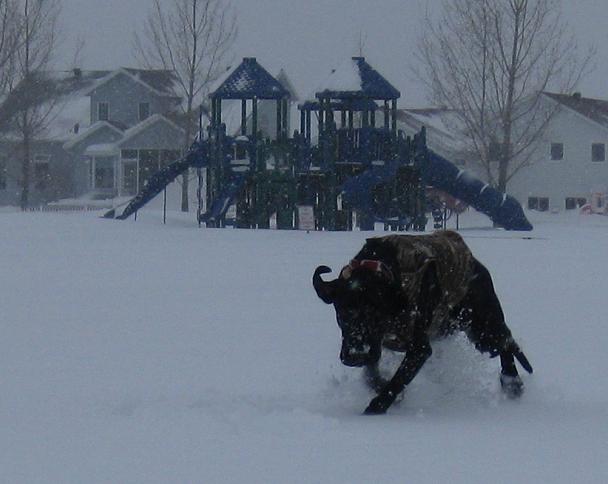
Is it just me, or does the picture of Ace in the snow look more like a charging bull?
[...] know their fate. Check out this great article we found from That Mutt: A Dog Blog about Ways to Prevent Losing Your Dog. Read the comments too. Lots of visitors to that site made some great [...]
Thanks, Dawn! He was charging at me, I know that!
I like the bell idea. My dog is small and quick. The bell would give me some warning. My dog is a rescue dog so she has a serial number tattooed on her so if she got lost and brought to the SPCA they can trace the number back to me. My main concern is traffic. If she get out she just darts across the street every time.
Yeah, anything to prevent her from getting out the door, especially if she is so small, drivers would have a harder time seeing her.
This is a great article,
I am interested in knowing any good ideas you have for protecting your on-leash dog while loose dogs charge up to you.
Stewie doesn’t like dogs running up and getting in his face, and he is on leash. Sometimes it is really scary.
thanks,
Nancy and Stewie JRT
Nice post. I had to laugh when you mentioned attaching bells to the small dogs. I guess some people’s dogs are quiet, but the shelties are vocal enough on their own, that I’d know if they escaped. No bells needed. LOL
I like the advice about training a recall. You just can’t stress that advice enough. I never cease to be amazed by the people that want their dogs to do agility, but they aren’t interested in teaching them basic skills that they need first, like a recall, a simple stay command, etc. A recall in my mind is a must-have!
Ugh, I have trouble with that too (referring to Nancy’s comment), not so much with Ace, but when I’m walking other people’s dogs that aren’t as comfortable accepting strangers.
One thing that seems to work well when an overly excited dog is charging is to keep a very confident posture, take a step forward between the two dogs and yell, “No!” loud enough to match the dog’s intensity. This usually surprises the dog and at least makes it hesitate a second. If the owner is around, then he or she will realize this behavior isn’t welcomed by you and hopefully will call the dog or come and get him. In the meantime, you can re-group and make sure to keep your own dog under control.
I know you are aware that making direct eye contact and holding your ground can be seen as a challenge to a dominant or aggressive dog, so there is a fine line. In this case, I would make sure to keep my own dog under control, stand with my side to the other dog so she sees I am not a threat and then slowly move away. 90% of the time though, the dog is just overly excited and not a real danger if I make sure to be the one in control.
Marie – Ha! I can see why you found the bell idea funny! You are right that most little dogs (if not all dogs) are pretty vocal at the door!
These are great comments (and a great post). Biggie’s microchipped and has a collar with his name and my phone # on it. He’s gotten loose a couple times – usually because he literally yanks the leash out of my hand going after something; training good loose lead walking and manners is a MUST.
One way to reinforce the coming back is to have a HUGE party when he comes back on his own. even if he’s been off for hours and you’re frustrated, when he finally does come back, it has to be the best thing in the world. Super high value treats, play, praise…
Good point, Biggie. It’s so hard not to be mad when they don’t come to us right away. But when they do, we can’t be mad about it, we have to at least pretend to be thrilled.
I hate it when people’s dogs charge me. While I’m by myself it is more manageable but when I have my dogs it is really an issue. Before I moved to Charleswood I lived in South Fargo and it was really an issue. I just had Duke at this time and there were two seperate incidents when a dog charged and attacked Duke while he was on his leash. Now when he sees a dog on a walk or run he often flips out and immediately goes on the defense, thanks so much irresponsible owners! He is getting better but I know he is still traumatized to a certain degree.
My dogs are whistle trained so I often carry that with me but if I happen to be caught without it they do listen to a vocal recall. It really helps if I call them with a high squeeky voice and I jump around. Sure I look like an idiot but it’s fun and interesting to them so they come running.
Yeah there are a lot of dogs that run around off leash in Fargo. I notice a lot of the owners of these dogs just assume my dog is friendly because he’s a black lab mix. He is friendly, but how would they know that from a distance? Plus, excited dogs running at us only encourages my dog to act excited.
My biggest pet peeve is dogs that come up to me on walks. That is one of the most rude things a dog owner can do to someone.
Yeah, it’s like a lot of dog owners just assume I want their dog charging up to me “to play.” Well, I don’t want my dog to learn to match the behavior of the other dog.
Ty, do you ever yell “No!” at the approaching dog when its owner is calling it and it continues to run up to you? Or do you just focus on your own dog?
I don’t take my dogs to the dog park any more, unless it is at some random time when I know someone else wont be there, becasue that place is just way out of controll these days. But when I did there would be dogs that would come up to Bailey my Vizla and nip at her, etc. This really scared her so when I saw another dog coming I would yell no at the dog while standing as tall as I could and pointing at the dog, it worked really well. Since moving to West Fargo I haven’t had to use this practice but I’m sure it would be just as effective.
*Vizsla
Yeah I don’t go to the dog park very often either. Unfortunaely it is a place where people take their out of control, unexercisd dogs. If dogs were walked before they went to the dog park and the park was used for a reward once the dogs were a little more tired, most of them wouldn’t act so crazy.
That was a good share. Very informative. Good tips. For all those people who really love & care their dogs, these are good advices. Thank you for that.
You’re welcome!